China Top 10 Stainless Steel Kitchen Faucet Manufacturers
Choosing a reliable supplier for a Stainless Steel Kitchen Faucet takes more than comparing polished product photos. Buyers need to examine material specifications, manufacturing experience, quality controls, and after-sales support. Small details matter. Ask whether the stated steel grade is documented, how finishes are tested, and what warranty terms actually cover. A brushed surface may hide fingerprints, but its appearance alone says little about long-term performance.
This guide introduces ten Chinese manufacturers and outlines practical points for comparing them. It considers product range, production capabilities, customization options, export experience, and the clarity of technical information. Where available, buyers should verify claims through product documents, factory audits, samples, and direct discussions with suppliers. These checks are useful, but they take time. A company website cannot confirm every detail, and public information may be incomplete or outdated. Rankings also depend on a buyer’s needs, budget, and target market. Treat this list as a starting point, not a substitute for due diligence. Before placing an order, confirm specifications, packaging, lead times, replacement-part availability, and communication expectations in writing. A faucet is a modest fixture, yet a poorly checked purchase can create avoidable installation and service problems.
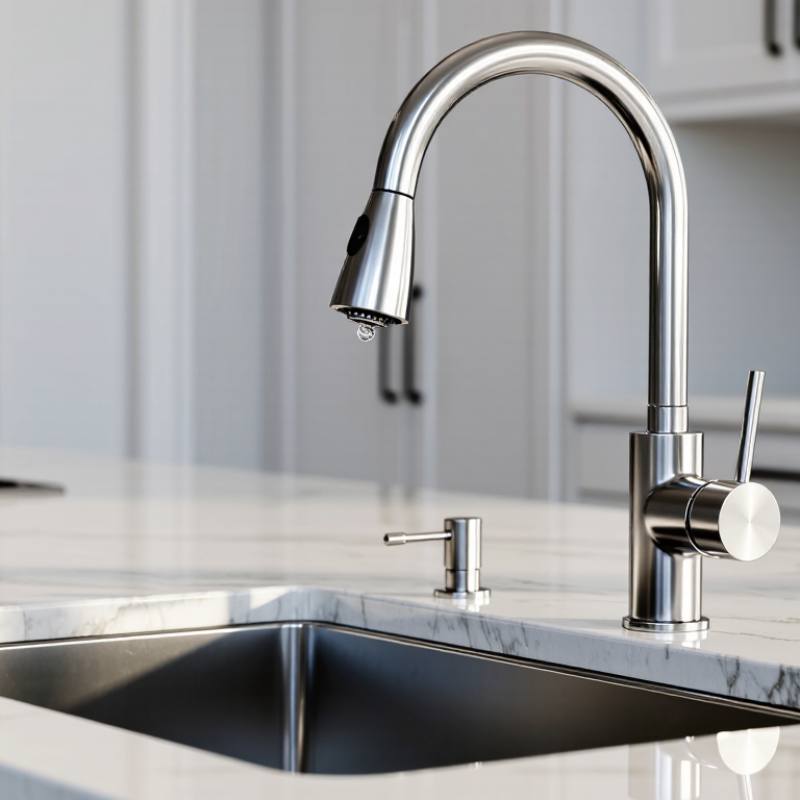
China’s Stainless Steel Kitchen Faucet Manufacturing Landscape
China’s stainless steel kitchen faucet manufacturing landscape is built around dense supplier networks, especially in coastal manufacturing regions. These networks connect metal processors, machining shops, surface-finishers, and component makers. A faucet may pass through several facilities before final assembly. That can improve production flexibility, but it also makes supplier oversight important.
Production quality depends on more than a polished surface. Makers may use casting or machining to form the faucet body, then grind and polish it to reduce visible marks. Inside, cartridge fit, hose connections, and seals affect daily performance. Small leaks matter. Buyers should check material traceability, dimensional inspection records, and water-pressure test procedures. A stated steel grade is useful, but paperwork should match the actual production batch.
Factories differ in equipment, testing discipline, and ability to handle custom designs. Some can maintain consistent finishes across large orders; smaller runs may show slight shade or texture differences. This is easy to overlook in sample reviews. Ask how samples are compared with bulk goods, and whether returned parts are examined for recurring defects. Clear answers are not a guarantee, but vague answers deserve a closer look.
China’s Stainless Steel Kitchen Faucet Manufacturing Landscape
Typical chromium content ranges in stainless steel grades relevant to kitchen faucet manufacturing
Chromium content is one factor affecting corrosion resistance. Grade selection also depends on factors such as nickel content, forming requirements, and cost. Values show typical ASTM A240 composition limits; verify the applicable specification for a particular product.
Criteria for Selecting the Top 10 Manufacturers
Selecting a stainless steel kitchen faucet manufacturer starts with the metal itself. Ask for material specifications and batch traceability, not just a polished sample. A faucet may look solid under showroom lights, yet reveal rough seams or uneven plating after daily use. Request production samples and inspect the handle movement, aerator, hose connections, and finish around the base.
Quality control should be visible in the process. Look for documented pressure, leak, and cartridge tests, with clear records for each production batch. Ask how defects are handled and whether replacement parts remain available. Specific answers matter. General promises do not. Independent audits or relevant quality certifications can add confidence, but verify their scope and validity rather than relying on a logo in a catalog.
Capacity and communication also affect supplier fit. Review realistic lead times, minimum order quantities, customization options, and packaging protection for long-distance shipping. A factory visit or live video walkthrough can show how parts move from machining to assembly. Still, no checklist is perfect; a small supplier may communicate well but have limited backup capacity. Compare evidence across several manufacturers, and note where information is missing before committing to a production order.
Profiles of 10 Leading Chinese Faucet Manufacturers
China’s stainless steel faucet manufacturers differ in scale, engineering focus, and production methods. These ten profiles describe useful capability types, not an independently audited ranking.
One manufacturer may specialize in compact workshops and custom dimensions. Another may focus on high-volume production, using automated polishing lines. A third could stand out for water-saving aerators and carefully tested flow rates. A fourth may offer flexible finishes, though coating durability needs close review. A fifth might build commercial-grade faucets with thicker bodies and replaceable cartridges. Small details matter.
A sixth profile is a supplier with strong export documentation and clear inspection records. A seventh may excel at developing prototypes from drawings, but have limited capacity for large orders. An eighth could prioritize lead-free material declarations and batch traceability. A ninth may offer broad product ranges, from pull-down kitchen faucets to simple mixer taps. A tenth may focus on integrated quality checks, including pressure tests and finish inspections. Buyers should verify these capabilities with current product samples, factory records, and written specifications. Catalog photos alone can hide uneven polishing or awkward handle movement. Manufacturers do not always describe limitations clearly; asking direct questions helps.
Products, Materials, Certifications, and Manufacturing Capabilities
A practical comparison of China’s leading stainless steel kitchen faucet manufacturers should look beyond product photos. Examine the faucet’s construction, including the body, spout, mounting hardware, and water-contact components. Confirm the stated stainless steel grade and ask how it applies to each part; some designs combine stainless steel with other materials. Small details matter. Check whether the finish is brushed, polished, or coated, and request samples when color consistency is important. A clear drawing can also reveal handle clearance and installation dimensions before an order is placed.
Manufacturing capability is best judged through documented processes, not broad claims. Ask about machining, welding, polishing, assembly, and leak or pressure testing. Request quality records and inspection criteria for the exact model. Certifications may cover particular products, factories, or markets, so verify their scope and validity rather than relying on a logo alone. Ask for evidence. Production capacity, minimum order quantities, sampling time, and spare-part availability help show whether a supplier fits the project. One useful caution: a polished sample does not prove every production unit will match it. Agree on acceptable finish variation and inspection steps in writing, then compare the delivered goods against those criteria.
How to Compare Manufacturers for Your Sourcing Needs
Compare factories on evidence, not catalog photos. Ask for a bill of materials naming the steel grade, brass alloy, cartridge supplier, and finish process. Request certificates tied to the actual production lot, then verify them independently where practical. Numbers need context. Ask for proof.
The World Stainless Association reported 58.4 million tonnes of global crude stainless-steel production in 2023, up 4.6% year over year. This indicates broad raw-material availability, not consistent faucet quality. Ask whether water-contact components use 304 stainless steel, and request corrosion-test results for the specific finish. A generic factory certificate is not enough.
Compare pressure and leak tests, cartridge-cycle results, flow-rate records, and inspection sampling. Request reports showing test methods, sample sizes, and pass criteria; a polished PDF alone proves little. Check NSF/ANSI/CAN 61 and NSF/ANSI 372 documentation when applicable to your market. Also compare minimum order quantities, replacement-part availability, packaging tests, and lead times against one shared specification sheet. Audits capture a moment, so repeat inspections matter.


