Containers in Motion

What Is Solid Surface Countertop and Is It Right for You?

A Solid Surface Counter Top can look deceptively simple: a smooth white plane, a nearly invisible seam, and a softly rounded edge. Underneath, however, it combines acrylic or polyester resin with mineral fillers. That composition creates a nonporous surface that resists everyday stains and supports integrated sinks. It also allows fabricators to repair light scratches through careful sanding. Small details matter.

Aaron Crowley, a veteran solid-surface fabricator and former ISFA president, puts it plainly: “Fabrication quality is what makes or breaks the material.” His point deserves attention. Even a premium sheet can disappoint when seams are poorly joined, edges are rushed, or cabinets cannot support the finished weight. A countertop is not only a product choice. It is an installation decision.

This guide examines what Solid Surface Counter Top means in practical terms. It considers appearance, durability, cleaning, heat resistance, cost, and repairability. Picture a busy kitchen with coffee rings, chopped herbs, and a warm baking tray near the sink. The material may handle some moments well, but it is not indestructible. Hot cookware still needs protection. Sharp knives still require a cutting board.

The honest question is not whether solid surface is perfect. It is whether its strengths match your habits, budget, and expectations. That answer may change from one household to another. Even experienced homeowners can overlook installation quality. A beautiful sample cannot reveal everything.
What Is Solid Surface Countertop and Is It Right for You?

What Is a Solid Surface Countertop?

A solid surface countertop is a manufactured sheet material made from acrylic, polyester, or a blend of both. Mineral fillers add weight, color, and a stone-like appearance. Unlike natural stone, its pattern usually runs through the material, not just across the top. A small cut or sanding repair may therefore become less noticeable.

The surface is nonporous, so spilled coffee, cooking oil, and everyday moisture cannot easily penetrate it. This makes cleaning simple and supports good kitchen hygiene. Seams can also be joined and sanded nearly smooth, creating a continuous appearance around sinks and backsplashes. In practical installations, this detail helps prevent crumbs from collecting in narrow joints.

It is not indestructible. Hot pans can damage the surface, and sharp knives may leave visible marks. Use trivets and a cutting board. Minor scratches can often be professionally sanded, but deeper damage may require a replacement section. That repairability is useful, though color matching is not always perfect.

Solid surface works well for homeowners who value clean lines, integrated sinks, and flexible shapes. It can be thermoformed into curved edges and custom details. However, it may not satisfy someone seeking the natural variation of granite or the strongest resistance to heat. Inspecting sample pieces under your actual kitchen lighting is wise. Colors can look unexpectedly different near windows.

How Solid Surface Countertops Are Made

Solid surface countertops are manufactured from a blend of mineral filler, acrylic or polyester resin, pigments, and curing agents. The mineral filler often contains alumina trihydrate, which gives the sheet weight and a stone-like appearance. Resin binds these particles together. Pigments are added throughout the mixture, not only on the surface.

Manufacturing begins by measuring each ingredient carefully. The mixture is blended until its color and texture become consistent. It is then poured into molds and cured under controlled heat. After curing, large panels are cut, calibrated, and sanded to create a smooth, even finish. Computer-controlled machines may shape sink openings, edges, and drainage grooves with high accuracy.

Installers join sections with color-matched adhesive. When the seam is sanded correctly, it can become difficult to see. Heat also allows the material to bend around selected curves. However, results depend on fabrication skill. A poorly prepared joint may remain visible. The material is nonporous and repairable, but it can scratch or show heat damage. That makes a cutting board and heat protector practical choices. Solid surface is adaptable, though perhaps less indestructible than some homeowners expect.

What Is Solid Surface Countertop and Is It Right for You?

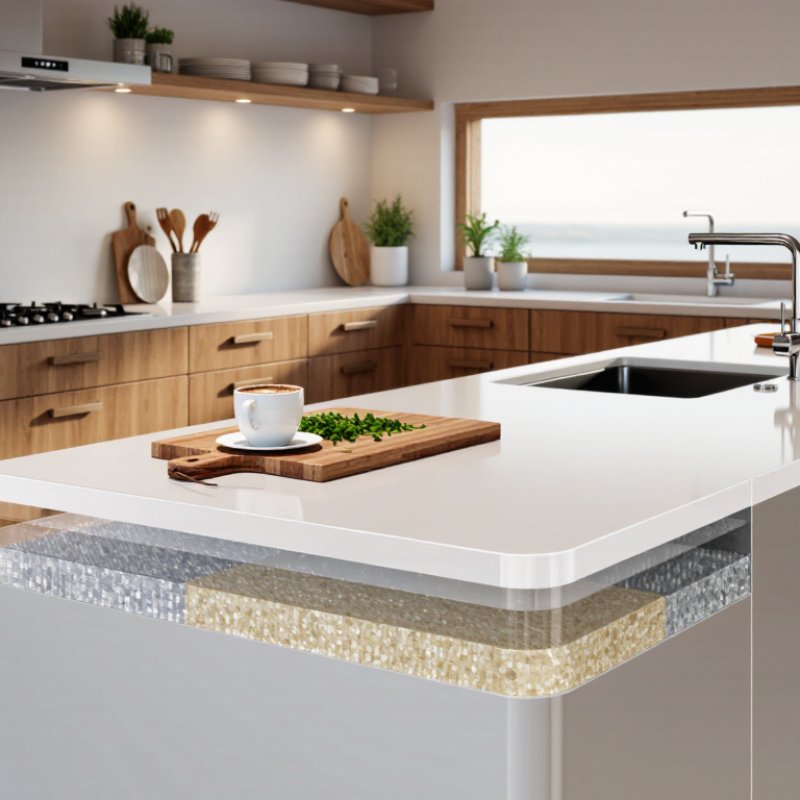
Solid surface countertops are manufactured from mineral filler, resin, pigments, and performance additives. The representative composition below reflects common industry formulations and may vary by product and thickness.

How it is made: Mineral filler and resin are blended with pigments and additives, cast into sheets, cured, and then cut, sanded, and polished. The nonporous, homogeneous material can be repaired and refinished because its color and structure extend throughout the sheet.

Key Features and Benefits of Solid Surface Countertops

What Is Solid Surface Countertop and Is It Right for You?

Solid surface countertops are engineered from acrylic or polyester resins blended with mineral fillers. They create a smooth, nonporous work surface with consistent color throughout. In kitchen projects, I have found this uniformity useful when matching an integrated sink or backsplash. Seams can be joined and sanded until they become difficult to notice. The result feels calm and continuous, especially in smaller rooms.

Daily care is straightforward. Wipe spills with mild soap and water, then dry the surface to reduce dull patches. Solid surface resists many household stains, but it is not indestructible. Hot pans, sharp knives, and abrasive cleaners can damage the finish. Minor scratches often can be professionally sanded, which is a practical advantage. Still, repairability should not replace careful use. Some darker colors reveal dust and fine marks more clearly. That detail is easy to underestimate.

Tips: Ask for a sample before ordering. View it beside your cabinets in daylight. Check the installer’s seam and support methods, especially around sinks and cooktops. Confirm the care instructions and repair process in writing. If you frequently place hot cookware directly on counters, another material may suit your habits better. A showroom sample cannot show every lighting change. That is worth remembering.

Limitations and Maintenance Requirements

Solid surface countertop is a uniform, nonporous material made from acrylic, polyester, or blended resins. It has no natural stone grain, so color remains relatively consistent across the surface. Seams can be joined and sanded, making them less visible. This feature helps create a clean, continuous worktop, especially around sinks and backsplashes.

Its limitations deserve careful attention. Heat is the trap. Hot pans, baking trays, and slow cookers can discolor or deform the surface without a protective trivet. Direct cutting also leaves scratches, although many minor marks can be sanded by a trained fabricator. It is not indestructible. Darker finishes may reveal scratches more clearly, while strong impacts can chip edges or damage corners. Large spans may also need proper cabinet support.

Daily care is simple but not careless. Wipe spills with warm water and mild dish soap, then dry the area to prevent dull residue. Avoid abrasive powders, harsh solvents, and rough scouring pads unless the care instructions specifically permit them. A soft cloth works better than aggressive scrubbing. For stubborn stains, test any cleaner on a hidden section first. It is easy to assume that a nonporous surface needs no attention; that assumption is wrong. Check seams, sink edges, and frequently used areas occasionally, because small damage can become harder to repair when ignored.

How to Decide If Solid Surface Is Right for You

Solid surface countertops suit homeowners who value a smooth, visually consistent worktop. The material is nonporous, so spills usually stay on the surface. Daily cleaning is simple with mild soap and a soft cloth. Integrated sinks can reduce visible seams and catch fewer crumbs. I have also seen homeowners appreciate the warm, matte feel during everyday cooking.

Your habits matter more than showroom appearance. If you often place hot pans directly on counters, this material may disappoint. Use trivets every time. It can scratch, although many shallow marks can be sanded by a trained professional. Darker colors often reveal scratches more clearly. Ask to see a large sample under your kitchen lighting, not only a small showroom chip.

Consider the fabricator’s experience carefully. Tight seams, curved edges, and sink cutouts require accurate measuring and skilled installation. Request details about repair methods and maintenance before signing an agreement. Solid surface may cost more than basic laminate, but it can offer long service with proper care. Still, it is not ideal for every household. Busy cooks may prefer stronger heat resistance, while minimalist homeowners may accept careful handling for a seamless appearance. I would reconsider the choice if constant caution would make the kitchen feel restrictive.

What Is Solid Surface Countertop and Is It Right for You? - How to Decide If Solid Surface Is Right for You

Decision Factor What Solid Surface Offers Practical Facts Suitability
Material composition A homogeneous, non-porous countertop material Typically made from a blend of mineral fillers and acrylic or polyester resins. The color and pattern extend through the material rather than existing only on a thin surface layer. Good for seamless designs
Seams and appearance Low-visibility, professionally joined seams Sections can be bonded and sanded to create a visually continuous surface. Integrated sinks and matching backsplashes are also possible with compatible fabrication. Excellent
Water resistance Non-porous surface It does not need routine sealing and does not readily absorb ordinary household spills when properly fabricated and maintained. Excellent
Hygiene and cleaning Simple everyday maintenance Most daily messes can be cleaned with a soft cloth, water, and mild soap or a suitable household cleaner. Avoid abrasive products unless the care instructions allow them. Excellent
Stain resistance Generally good resistance to common spills Because the surface is non-porous, many spills remain on the surface. Strong dyes, harsh chemicals, or prolonged contact with staining substances can still cause discoloration. Good
Scratch resistance Moderate resistance, with repair potential Knives, abrasive materials, and gritty particles can scratch the surface. Minor scratches can often be removed or reduced by sanding and refinishing by a qualified professional. Good with care
Heat resistance Suitable for normal countertop use, but not direct high heat Hot cookware should be placed on trivets or heat pads. Direct contact with very hot pots, pans, appliances, or open flames may cause discoloration, deformation, or other damage. Requires caution
Impact resistance Good everyday durability Normal household impacts are usually manageable, but sharp or heavy objects can chip edges, corners, or sink cutouts. Edge profiles and fabrication quality affect performance. Good
Repairability Often repairable rather than fully replaceable Light scratches, small stains, and some minor damage may be refinished. Severe cracks, burns, or structural damage may require a specialist or replacement section. Very good
Design flexibility Broad range of colors, patterns, edge profiles, and shapes The material can be cut, thermoformed, routed, and shaped for curved details or custom layouts. Availability of specific colors and fabrication options varies by supplier. Excellent
Installation requirements Usually installed by experienced fabricators Large pieces can be heavy, and accurate cutting, joining, sanding, and support are important. Professional installation is commonly preferred for seamless results. Professional work advised
Long-term maintenance Low routine maintenance Regular sealing is generally unnecessary. The finish may gradually develop a softer appearance, and periodic professional refinishing can restore a more uniform look if needed. Low maintenance
Environmental considerations Long service life and potential repairability Durability and repair can reduce the need for early replacement. End-of-life recycling options are limited and depend on local collection and material-recovery programs. Evaluate locally
Best suited for Kitchens, bathrooms, utility areas, and custom built-ins A practical choice for people who value easy cleaning, integrated details, soft-to-the-touch finishes, and nearly invisible seams over maximum heat resistance. Strong overall fit
May not be ideal for High-heat or heavy-abuse environments Consider another material if direct hot-pan placement, frequent cutting directly on the surface, or a naturally heat-resistant surface is a top priority. Compare alternatives

Decision summary: Solid surface is a strong option when seamless appearance, non-porous performance, easy cleaning, and repairability matter most. Use trivets, cutting boards, and manufacturer-approved cleaners to help preserve the countertop.