7 Best Bird Control Spikes for Global Buyers
Choosing the right Bird Control Spikes requires more than comparing prices and stainless-steel finishes. Global buyers must assess bird species, ledge depth, weather exposure, installation surfaces, maintenance access, and local animal-welfare requirements. A product suitable for pigeons on a concrete parapet may perform poorly against gulls on a coastal warehouse roof.
The need is measurable. The U.S. Federal Aviation Administration recorded 19,367 wildlife strikes in 2023, with birds representing the overwhelming majority of reported incidents. The FAA Wildlife Hazard Management Program also stresses habitat control, monitoring, and layered prevention rather than relying on one device. Grand View Research identifies commercial buildings, transportation sites, and industrial facilities as important areas within the wider bird-control market. These reports do not prove that every spike system works equally well. They show why careful product selection matters.
Wildlife damage management specialist Dr. Scott E. Hygnstrom expresses the responsible principle clearly: “The goal is to reduce damage, not eliminate wildlife.” That idea should guide every Bird Control Spikes comparison. Effective spikes should discourage landing without creating unnecessary injury, while remaining securely attached during wind, rain, and seasonal temperature changes. Small details matter. Weak adhesive, exposed gaps, or poorly spaced wires can leave a narrow landing zone.
Some recommendations remain imperfect. Installation quality is often harder to judge online. This guide compares seven practical options using material durability, coverage, mounting flexibility, maintenance needs, and buyer feedback. It also recognizes a limitation: no spike system replaces cleaning, exclusion, and routine inspection.
What Bird Control Spikes Are and How They Work
7 Best Bird Control Spikes for Global Buyers
Bird control spikes are physical deterrents fitted to ledges, roofs, signs, and narrow surfaces. Their pointed rows make landing uncomfortable, without trapping or injuring birds when installed correctly.
Most models use weather-resistant plastic or stainless steel bases. The choice depends on surface width, exposure, and local bird activity.
The spikes work by removing a stable landing space. Birds may circle nearby, but they cannot settle easily on the protected edge. Proper coverage matters. Gaps between sections can become convenient landing points.
Before installation, clean droppings, check the surface condition, and measure the full area.
On dusty concrete or aging masonry, adhesive alone may fail. Mechanical fixing may be more reliable, but the surface must allow it.
Tips: Select rounded, humane designs with clear installation guidance. Use enough sections to cover corners and gaps. Inspect them after storms, especially on tall buildings.
Spikes are not a perfect cure. Birds may move to nearby ledges, so broader site management is sometimes needed.
Do not block drainage or emergency access. When nesting is present, pause and seek qualified local advice before disturbing the area.
Simple installation can still go wrong. Regular checks make the system safer and more dependable.
Key Factors Global Buyers Should Compare
7 Best Bird Control Spikes for Global Buyers: Key Factors Global Buyers Should Compare
Global buyers should compare bird control spikes by material, design, installation, and lifecycle cost. Stainless steel usually resists coastal corrosion better than untreated steel. However, material alone does not guarantee durability. Check the stated grade, weld quality, UV resistance, and salt-spray test results. ISO 9227 provides a recognized method for evaluating corrosion resistance, although laboratory results cannot fully represent every rooftop.
Fit matters. Spike width should match the ledge, pipe, sign, or beam being protected. A weak adhesive base may fail on dusty concrete, painted metal, or freezing surfaces. Mechanical fasteners can perform better, but drilling may damage waterproofing. The FAA Wildlife Strike Database recorded more than 19,000 reported wildlife strikes in 2023. This figure concerns aviation, not buildings, yet it shows why reliable bird-management planning matters. Spikes should discourage perching without sharp exposed edges that create unnecessary injury risks. Design details deserve careful review.
Global buyers should also compare wind resistance, drainage, packaging, replacement parts, and installation instructions. Request test documents, dimensional drawings, and cleaning guidance before purchase. In humid regions, trapped water beneath the base can accelerate failure. In hot climates, adhesive softening becomes a real concern. Cost is easy to compare; maintenance is not. I have seen projects choose cheaper units and replace them too soon. That lesson is uncomfortable. Select products tested for the target climate, supported by traceable technical data, and installed by trained personnel. There is no universal “best” spike.
Seven Bird Control Spike Options for Different Applications
7 Best Bird Control Spikes for Global Buyers
Seven Bird Control Spike Options for Different Applications
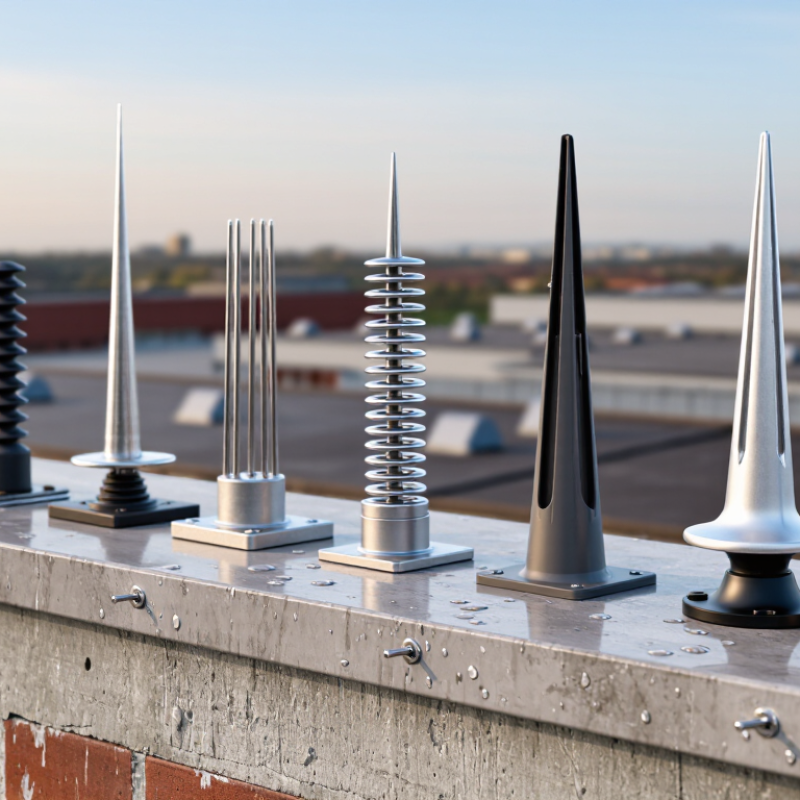
Selecting bird control spikes starts with the surface, bird size, weather, and cleaning access. During site inspections, I check droppings, nesting corners, ledge depth, and drainage paths. Seven options cover common applications. Stainless steel spikes suit exposed masonry and coastal sites where corrosion resistance matters. UV-stabilized polycarbonate spikes fit lighter residential ledges and discreet façades. Narrow, low-profile spikes work on signs, window frames, and shallow rails. Less visual clutter. Short sentences.
Wide-base spikes provide better coverage on broad parapets and warehouse beams. Adjustable modular spikes follow uneven stone, curved caps, or changing ledge widths. Adhesive-backed units help on delicate surfaces where drilling could cause damage, but preparation is unforgiving. Screw-mounted heavy-duty spikes suit industrial areas facing strong wind, ice, or repeated cleaning. Large birds may require wider coverage than small urban species. One design cannot solve every site problem.
Reliable installation uses compatible fasteners, measured spacing, sealed penetrations, and routine checks. Confirm local wildlife requirements before installation, especially near active nests. Spikes should deter landing, not trap birds. Inspect them after storms. Adhesive can lift. I have seen good layouts fail because dust remained beneath the bonding strip. That mistake is easy to repeat. Consider UV exposure, temperature changes, roof access, and replacement needs. A small test section can reveal glare, gaps, or poor adhesion before full installation. The process is practical, but never perfect.
How to Evaluate Suppliers, Standards, and Shipping Terms
Global buyers should compare seven spike types by site condition, not by catalog ranking. Stainless-steel spikes suit coastal roofs and heavy weather. UV-stabilized polycarbonate models reduce weight and freight costs. Narrow-base designs fit ledges, while wide-base versions cover rough concrete. Flexible systems work around signs and curved surfaces. For warehouses, taller deterrents may protect beams better. Always request drawings, base width, pin height, and coverage per meter.
Supplier evidence matters more than polished photos. Ask for material grades, tensile data, adhesive instructions, and batch inspection records. ASTM G154 or ISO 4892-3 testing can support UV claims. ASTM B117 may indicate corrosion-testing practice, but it is not a universal bird-spike certification. ISO’s 2023 survey recorded more than 1.2 million ISO 9001 certificates worldwide, yet certification alone does not prove outdoor performance. Check factory samples. Test them on dusty, wet surfaces.
Shipping terms deserve equal attention. UNCTAD’s Review of Maritime Transport 2023 states that over 80% of global merchandise trade by volume moves by sea. Compare carton dimensions, pallet counts, moisture barriers, and spare-pin ratios. Under ICC Incoterms 2020, clarify who pays freight, insurance, customs handling, and destination charges. Delivered pricing can hide local taxes. I have seen low-priced samples arrive with bent pins after weak carton packing. That detail is easy to overlook. Ask for loading photos, inspection reports, and a written claim process before ordering.
7 Best Bird Control Spikes for Global Buyers
Comparative benchmark of common bird-spike configurations using typical product specifications: stainless-steel grade, spike height, base coverage width, and estimated durability. Buyers should verify test reports, material certificates, packaging, and Incoterms with each supplier.
Wider bases cover more surface with fewer installation rows, while taller stainless-steel spikes generally provide stronger deterrence for larger birds. For international purchasing, request documentation for stainless-steel composition, UV resistance, adhesive performance, carton dimensions, and the agreed shipping term such as FOB, CIF, or DDP.


