Containers in Motion

7 Bed Side Cabinet Buying Tips for Global Buyers?

A Bed Side Cabinet may look like a small purchase, but global sourcing makes its details commercially important. Grand View Research valued the global furniture market at approximately USD 516.6 billion in 2022. Its report also projects steady growth through 2030. This expansion increases supplier choice, but it also increases quality differences. A low quotation can hide weak drawer runners, unstable legs, poor packaging, or expensive returns.

Small details matter. Buyers should assess dimensions, storage capacity, materials, surface finishes, hardware, safety, packaging, and total landed cost. The EU’s 2023 Safety Gate report recorded thousands of dangerous product notifications across consumer categories. It reminds importers to verify product safety before shipment. Requirements may differ between the European Union, North America, the Middle East, and other markets. Therefore, a supplier’s attractive catalogue cannot replace documented testing, clear specifications, and factory inspection.

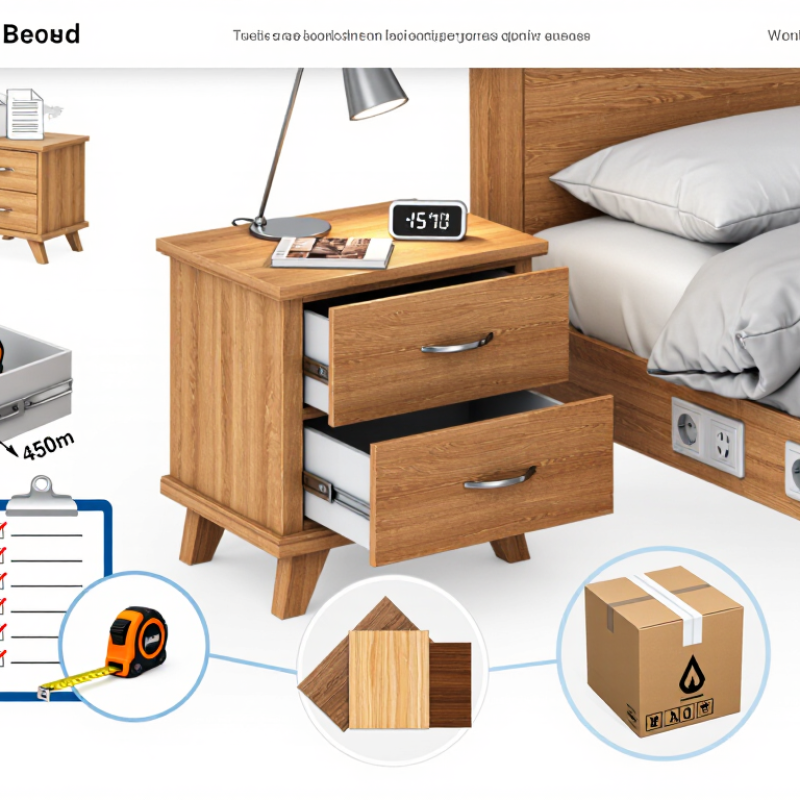
This guide presents seven practical buying tips for international buyers. It focuses on usable evidence, not attractive promises. Check whether the cabinet fits beside a standard bed without blocking sockets. Confirm that a 450-millimetre drawer opens smoothly after delivery. Request material declarations, load information, carton drop-test results, and photos from production. The Forest Stewardship Council also provides a recognized framework for responsible wood sourcing, where certified timber is commercially important. No checklist is perfect. Even experienced buyers can overlook moisture movement or colour variation. A careful process reduces those surprises and protects margins, customer trust, and long-term supplier relationships.
7 Bed Side Cabinet Buying Tips for Global Buyers?

Understanding Bedside Cabinet Types and Buyer Requirements

Choosing a bedside cabinet starts with understanding its type and the buyer’s actual use. A drawer model suits bedrooms needing private storage, while an open-shelf design gives quick access to books and glasses. Wall-mounted cabinets save floor space, but they require reliable wall fixing. Rolling cabinets may help care facilities, although their wheels can increase cleaning demands.

Measure the available width, depth, and bed height before comparing suppliers. A cabinet that looks compact online may block a walkway in a small room. Check the drawer’s internal height, runner smoothness, handle comfort, and door clearance. Materials also matter. Moisture-resistant panels suit humid regions, while solid wood may appeal to buyers seeking a warmer appearance. Ask for sample finishes, edge details, load capacity, and assembly instructions.

Global buyers should define packaging, labeling, quality checks, and delivery conditions early. Inspect corner protection and carton strength, especially for long-distance shipments. Request a pre-production sample when the order is substantial. I once underestimated how much a small color difference affected a coordinated bedroom project. That mistake was avoidable. Buyer requirements also vary by market, room size, user age, and cleaning habits. Some customers need rounded corners and easy-grip handles. Others value cable openings, hidden compartments, or adjustable feet. Do not assume one design fits every household. Test the cabinet beside a real bed, not only in a catalog image.

Checking Size, Storage Capacity, and Bedroom Compatibility

7 Bed Side Cabinet Buying Tips for Global Buyers

A bedside cabinet should fit the room, not merely fill an empty corner. Measure the available width, depth, and height before comparing products. Leave enough space to open drawers and walk comfortably beside the bed. A cabinet that looks compact online may feel bulky in a narrow bedroom.

Check the cabinet height against your mattress surface. A top that sits near mattress level makes lamps, glasses, and books easier to reach. Measure the mattress, bed frame, and floor clearance together. Small differences matter. I once chose a cabinet that seemed suitable, but its drawers hit the bed frame. That mistake was avoidable.

Storage capacity should match daily habits. One drawer may suit a minimalist room, while shelves can hold baskets, chargers, or medical reading glasses. Check internal dimensions, not only the external size. A deep drawer is useful, but poor runners can make it frustrating. Ask about weight limits, assembly instructions, and replacement hardware. These details often reveal manufacturing quality.

Bedroom compatibility involves more than appearance. Compare the cabinet’s color, handle style, and surface finish with the bed and flooring. Consider humidity, dust, and cleaning routines in your region. Smooth surfaces are easier to maintain, though they may show fingerprints. Cable openings can keep charging wires organized. They are not always positioned well, so inspect the design carefully. When buying internationally, confirm measurements in familiar units and check whether the delivered cabinet can pass through doors, lifts, and stairways.

7 Bedside Cabinet Buying Tips for Global Buyers: Checking Size, Storage Capacity, and Bedroom Compatibility

Tip Key Dimension or Data Point Practical Buying Guideline Why It Matters Bedroom Compatibility Check Priority
1Match the cabinet height Typical cabinet height: 50–70 cm Choose a cabinet top that is level with, or up to 10 cm below, the top of the mattress. A suitable height keeps lamps, phones, books, and water within comfortable reach without excessive bending. Measure from the floor to the top of the mattress, not only to the bed frame. High
2Confirm available floor space Common width: 35–60 cm
Common depth: 30–45 cm
Leave at least 5 cm between the cabinet and the bed, and keep walkways approximately 60 cm wide where possible. Proper clearance prevents blocked circulation, difficult cleaning, and accidental contact with drawers or doors. Measure the wall, skirting board, bed frame, electrical outlets, and nearby furniture before ordering. High
3Evaluate storage capacity Useful internal capacity: approximately 15–35 liters For basic bedside use, select at least one drawer or enclosed compartment with an internal height of 10–15 cm. Capacity should accommodate reading materials, charging cables, medication, glasses, and personal items without overfilling. Compare internal dimensions rather than external dimensions, especially when the cabinet has thick panels or framing. High
4Check drawer and door operation Recommended front clearance: 45–60 cm Allow enough space for a drawer to open fully or for a hinged door to swing without hitting the bed. Restricted opening reduces usable storage and may cause damage to handles, walls, or adjacent furniture. For narrow rooms, consider sliding doors, open shelving, or drawers with a compact extension design. High
5Review load and stability Suggested top load: 10–20 kg
Suggested drawer load: 3–8 kg
Confirm the stated load rating and prefer a wide, stable base with level-adjustment options. A stable cabinet supports lamps and everyday objects while reducing tipping and uneven-floor problems. For households with children or pets, use wall anchoring where appropriate and avoid placing heavy items near the edge. High
6Check electrical and cable access Useful rear cable opening: approximately 30–50 mm in diameter or width Look for rear clearance, cable-management openings, or a recessed back panel if a lamp or charger will sit on top. Good cable access keeps wires organized and prevents the cabinet from pressing against wall sockets. Measure socket height and position; verify compatibility with the destination country’s plug, voltage, and safety requirements for electrical accessories. Medium
7Match materials and maintenance needs Common options: solid wood, engineered wood, metal, and mixed materials For bedrooms with changing humidity, select sealed surfaces, moisture-resistant panels, and easy-clean finishes. Material choice affects durability, appearance, weight, cleaning effort, and resistance to scratches or moisture. Check the room style, floor type, color palette, climate, and delivery environment before selecting the finish. Medium

Evaluating Materials, Construction Quality, and Safety Features

7 Bed Side Cabinet Buying Tips for Global Buyers?

A bedside cabinet should withstand nightly opening, spills, and uneven floors. Solid wood feels durable, but quality plywood can resist warping better in humid rooms. Inspect the edges, veneer, and back panel closely. Exposed particleboard near the floor may absorb moisture quickly. Small gaps matter.

Construction quality appears in the details. Check whether joints use dowels, screws, or only adhesive. Pull each drawer fully and listen for grinding. Metal runners should move smoothly and support the stated load. The U.S. Consumer Product Safety Commission estimated about 22,000 furniture tip-over injuries and 71 deaths from 2018 to 2020. An anti-tip device, stable base, and secure wall-fixing point are essential, even for a small cabinet.

Safety also includes materials and daily contact. Ask for formaldehyde-emission documentation, especially for composite wood. U.S. EPA TSCA Title VI requirements provide a useful benchmark for composite-wood emissions, though local rules may differ. Rounded corners reduce impact injuries beside a bed. Avoid loose knobs and sharp metal edges. Test it yourself. A certificate helps, but it cannot replace a physical inspection. I have seen attractive cabinets hide weak rear panels and poorly fixed runners. Humidity, shipping vibration, and installation mistakes can expose those weaknesses.

Comparing Suppliers, Prices, Certifications, and Customization Options

7 Bed Side Cabinet Buying Tips for Global Buyers

Comparing suppliers requires more than reading a product catalog. Ask for factory photos, production capacity, material specifications, and recent quality records. A reliable supplier should explain drawer construction, edge finishing, moisture resistance, and packaging methods clearly. Request a physical sample when possible. A cabinet may look excellent online but feel unstable beside a bed. Check dimensions, drawer movement, surface durability, and odor before approving bulk production. Small details matter.

Compare total landed cost, not only the unit price. Include tooling, sample fees, packaging, shipping, insurance, duties, and possible inspection costs. An unusually low quotation may exclude protective corners or proper carton strength. I still find price comparisons difficult when suppliers use different delivery terms. That uncertainty deserves written clarification. Certifications should match the destination market and product materials. Request valid test reports, factory declarations, and certification scope, rather than accepting copied certificates. Confirm whether the documents cover panels, coatings, adhesives, and electrical parts if included.

Customization can involve colors, handles, drawer layouts, dimensions, logos, and packaging. Define every change in a signed specification sheet. Even a two-millimeter adjustment can affect packing and assembly. Ask about minimum order quantities, sample approval, lead time, and replacement procedures. Flexible suppliers may support custom designs, but flexibility can also increase errors. Keep the drawing simple, measurable, and realistic.

Planning Shipping, Import Compliance, Warranty, and After-Sales Support

For global buyers, a bedside cabinet is small furniture, not a small logistics job. UNCTAD’s Review of Maritime Transport reports that over 80% of global merchandise trade by volume moves by sea. Confirm Incoterms, carton dimensions, gross weight, stack limits, and the port of discharge before payment. A 20-millimeter corner protector can matter. Request moisture barriers and drop-test evidence, because particleboard may swell after a wet container journey.

Import compliance needs a destination-specific checklist. Verify tariff classification, wood-panel emission rules, packaging marks, and anchoring requirements. Requirements differ by market. Request material declarations, test reports, assembly instructions, and invoices with matching product descriptions. The World Bank’s 2023 Logistics Performance Index shows uneven customs efficiency, infrastructure, and delivery timeliness across economies. Cheap freight can create expensive storage. Do not assume the supplier knows every local rule.

Warranty terms should define coverage, claim deadlines, labor, spare parts, and return freight. Photograph carton labels and damage within 48 hours. Keep spare hinges, screws, handles, and touch-up materials near the service team. The 2024 National Retail Federation report estimated U.S. retail returns at 16.9% of annual sales, worth about 890 billion dollars. Furniture returns can cost more because of volume and handling. Test one cabinet through complete assembly before bulk shipment. I learned this the hard way: a perfect showroom sample proves little when instructions are unclear.