Containers in Motion

Top 10 Foldable Tables for Wholesale Buyers?

Wholesale buyers rarely need a table that looks impressive only in a catalog. They need reliable stock, predictable landed costs, and products that store neatly between orders. A Foldable Table can serve schools, venues, retailers, caterers, and rental operators. Yet small details matter: hinge resistance, edge finish, leg locks, carton size, and replacement-part availability.

The wider furniture market gives useful context, though it cannot predict demand for folding tables by itself. Grand View Research estimated the global furniture market at USD 677.09 billion in 2022 and projected growth through 2030. That figure describes furniture overall, not this product category. It is a signal, not a buying verdict. Buyers should also compare supplier specifications, sample quality, warranty terms, and shipping dimensions before committing to volume.

This guide reviews ten foldable tables for wholesale buyers, with attention to practical trade-offs rather than polished claims. A lightweight plastic model may suit frequent transport, while a thicker tabletop can feel steadier in daily use. Steel frames, locking mechanisms, and compact storage profiles also deserve close inspection. Small tests help. Open and close samples repeatedly; check for wobble on a hard floor. Some product details remain hard to judge from photos, and that limitation matters. The right choice depends on the buyer’s channel, customer, and handling conditions—not simply the lowest unit price.
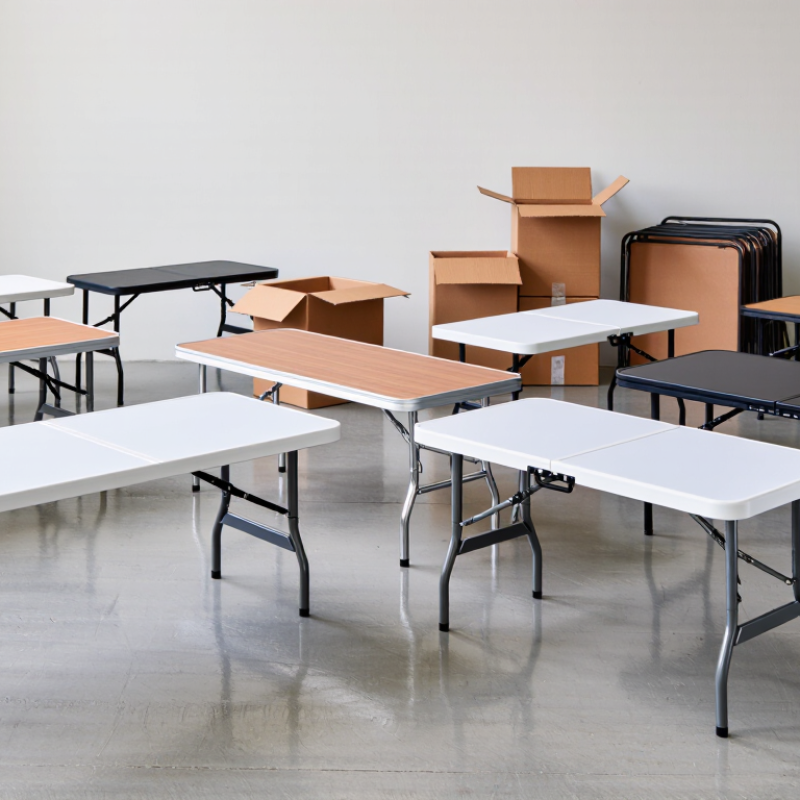
Top 10 Foldable Tables for Wholesale Buyers?

What Wholesale Buyers Need to Know About Foldable Tables

Wholesale buyers should judge foldable tables as working equipment, not just low-cost surfaces. Check the open and folded dimensions, table weight, stated load capacity, and how securely each leg locks. Ask for test records, not only a catalog claim. For busy venues, inspect the hinge area and feet closely; these parts take repeated knocks against floors and loading carts. Small details matter. Compare samples after repeated setup and folding, and note whether the tabletop flexes or the frame shifts. A sample test is useful, but it cannot reproduce every delivery route or user.

Packaging and replacement parts deserve equal attention. The National Retail Federation’s 2024 Retail Returns Report estimated that 16.9% of U.S. retail sales were returned. That figure covers retail broadly, not foldable tables specifically, but it shows why damaged goods and unclear specifications can become costly. Ask suppliers how they protect corners, label cartons, and handle missing hardware. Confirm that replacement feet or locking components can be ordered separately. One weak point remains: buyer checklists cannot predict rough handling at every warehouse. Record inspection results by batch, then review complaints before placing a larger order.

Key Criteria for Evaluating Foldable Tables in Bulk

Wholesale buyers should assess foldable tables by more than price and appearance. Check the stated load capacity and ask whether it applies evenly across the tabletop. A table holding weight at its center may behave differently when equipment sits near an edge. Inspect the frame, locking hinges, and feet for wobble or exposed pinch points. Test it loaded. Also compare open and folded dimensions; a few centimeters can affect storage and shipping plans. Surface material matters, too. A smooth, sealed top is easier to wipe, while thin edges may show damage after repeated handling.

Tips: Request a sample before placing a large order. Open and fold it several times, then check that the locks engage cleanly. Keep notes on carton dimensions, table weight, and replacement-part availability.

For larger quantities, ask for consistent specifications across the production run and written details on tolerances, packaging, and warranty coverage. Confirm how tables are stacked in cartons; crushed corners can turn a low unit price into extra handling work. If possible, inspect a packed sample, not only an assembled one. Small details matter. A checklist helps, though it will not catch every issue—buyers may still need to revise their criteria after seeing the first shipment.

Ten Foldable Table Types and Their Best Uses

Banquet tables suit catered events and training sessions, where long rows make setup simple. Round folding tables encourage conversation at receptions or community dinners. Cocktail tables provide compact standing space for drinks and quick discussions. Card tables work for game nights, temporary registration desks, or small vendor displays. Adjustable-height tables help when users need to alternate between sitting and standing. Small detail: check how securely each height locks.

For cafeterias and multipurpose rooms, folding cafeteria tables with attached benches can speed up seating and storage. Seminar tables offer narrow work surfaces for classrooms and meeting spaces. Portable camping tables are useful for outdoor sales, picnics, and temporary service stations; lighter models may feel less steady on uneven ground. Wall-mounted folding tables save floor space in compact rooms or service areas. Nesting folding tables stack closely, making them practical for venues that rearrange layouts often. Still, a tidy specification sheet cannot reveal every wobble or awkward latch.

Tips: Ask for open and folded dimensions, table weight, load rating, and frame material. Test a sample on the intended floor, and fold it several times. Measure storage doors too. A table that fits the room but cannot pass through the doorway is a frustrating mistake.

Comparing Materials, Sizes, Weight Limits, and Storage Needs

When comparing the top 10 foldable tables for wholesale orders, match material to use, not appearance alone. Steel frames often suit frequent indoor setup, while aluminum can reduce carrying weight. Resin tops handle quick wipe-downs; plywood gives a firmer, more traditional surface but needs protection from moisture. The USDA Forest Products Laboratory’s Wood Handbook (FPL-GTR-282, 2021) documents how wood species and moisture affect density and performance. Ask suppliers for top thickness, frame finish, and care instructions. Small details matter.

Compare both open and folded dimensions. A 6-foot table may serve banquet layouts, yet its folded length can complicate van loading or narrow storerooms. Check the stated weight limit and how it was tested; evenly distributed static load is not the same as a person leaning on one edge. NIOSH’s Revised Lifting Equation manual sets 51 pounds as the recommended limit only under ideal lifting conditions, with lower limits as handling conditions worsen. That makes table weight a real purchasing factor, not a footnote. Measure shelf clearance, aisle width, and stack height before ordering. I would not assume nested tables save space until I test a sample; hinges and feet can catch, and specifications sometimes omit that awkward detail.

Top 10 Foldable Tables for Wholesale Buyers: Capacity & Storage Comparison

Compare common table formats by representative load capacity, material, size, and folded storage footprint.

Load figures are rounded, representative examples for evenly distributed static loads—not universal guarantees. Actual ratings and folded dimensions vary by model; verify specifications and test requirements with the supplier before purchasing.

Table Type Typical Material Open Size (approx.) Example Load Limit Folded Storage Size (approx.)
6 ft center-fold banquetHDPE top, steel frame72 × 30 in330 lb36 × 30 × 4 in
6 ft bi-fold banquetHDPE top, steel frame72 × 30 in300 lb36 × 30 × 4 in
8 ft banquetHDPE top, steel frame96 × 30 in300 lb48 × 30 × 4 in
4 ft utility tableHDPE top, steel frame48 × 24 in300 lb24 × 24 × 4 in
48 in round tableHDPE top, steel frame48 in diameter330 lb48 × 24 × 4 in
60 in round tableHDPE top, steel frame60 in diameter330 lb60 × 30 × 4 in
6 ft plywood banquetPlywood top, steel frame72 × 30 in500 lb72 × 30 × 3 in
4 ft steel utility tableSteel top and frame48 × 24 in250 lb48 × 24 × 3 in
6 ft aluminum folding tableAluminum top and frame72 × 30 in300 lb72 × 30 × 3 in
34 in card tableVinyl-covered top, steel frame34 × 34 in200 lb34 × 17 × 3 in

How to Select Suppliers and Plan a Wholesale Purchase

Selecting a foldable-table supplier starts with the job the tables must do. A café terrace, school hall, and weekend market need different sizes, finishes, and storage formats. Ask for a current specification sheet showing open dimensions, folded thickness, frame material, tabletop finish, and rated load. Request a sample, then open and fold it repeatedly on a hard floor. Check hinge play, leg locks, sharp edges, wobble, and whether the feet scratch tile. Small details matter. A stated capacity is useful, but ask how it was tested and whether it applies to evenly distributed weight.

Before placing a bulk order, compare the full delivered cost, not just the unit price. Include packaging, freight, duties where applicable, inspection, and replacement terms. Confirm minimum order quantity, production lead time, carton dimensions, and how defects are handled. Ask for photos of packed cartons and a written pre-shipment checklist. If possible, inspect a few units from the production run, not only the polished sample. Keep it simple. Start with a quantity your storage space and sales history can support, then agree on reorder timing. Forecasts are rarely exact. Leave room for slower-selling colors or seasonal demand; even careful buyers can misjudge a first order. A clear contract and dated specifications reduce confusion when details change.